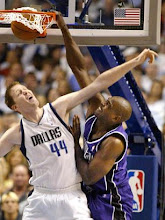
Hey, it's been a while since I posted here. Work, eh? I've probably bemoaned the idea of the all-star game in the past before. The NBA mid season showcase always brings about lots of arguments, because there are only 12 spots per conference. This year, conference imbalance seems to be the talk, but it's not the first time. Remember in 2001 when seven west teams won 50 games, and only three from the east? Or the next year, when the Nets finished first in the east with 52 wins? Or the next year when the Pistons finished first with just 50 and no one else got there? Or how about ... yeah, you get it, there have been lots of years recently in which one conference has been considerably stronger. Usually, it's the west. This year is no different; currently, seven teams are on pace to win 52 games, and Phoenix and Oklahoma City will have to fight it out just to get that last spot. Last year, it was a similarly crazy race in the west, while everyone outside Miami and Indiana in the east was... not that good.
Once again, people are arguing about the all-star game and how it should be changed to reflect this. There are a lot of great players who will be snubbed from the west team, while the east team may struggle to find 12 really good candidates. As someone who can remember when the east all-stars started Anthony Mason and Antonio Davis as their big guys (2001, look it up) against Shaq and Duncan, I can tell you this is nothing new. I've always seen the conferences go up and down, and I used to complain about it, but then I stopped caring. I figured it would always be a little unfair somehow, and while I disagreed with certain selections, I didn't really push for major changes.
Until now.
This week, I was watching the Pro Bowl, by which I mean I was reading sportswriters' tweets about the Pro Bowl. The Pro Bowl sucks and is even more pointless in the week before the Super Bowl.... but it did add a kinda interesting wrinkle when they assigned two honorary captains to pick players, as opposed to just splitting them up by conference. While the NFL's all-star game is terrible and works much better on paper than in a real game, if they can feel fine with mixing up two conferences that have long been separated for everything, why can't the NBA? I also found out that the NHL tried something like this for their all-star game (I know almost nothing about hockey, so feel free to correct me on this) and was also considering having the teams be North Americans vs. Europeans. Maybe they already did that. I like that idea.
These two all-star games are not as fun or as big as the NBA's, but they showed everyone that old traditions can be changed and it might work better. I think the NBA would be more open to changes in the all-star process now, as they've already implemented several in the past few years. They made it so that centers and forwards go together, because it's hard to find true centers nowadays. This is now part of the selection process for the starters as well as the bench.
[If you're unfamiliar with the all-star process, fans vote for 5 starters, being 2 guards and 3 frontcourt players, in each conference. The biggest vote recipients in each category get to start the all-star game, no matter how unqualified they are. This has led to some very popular but not great players voted in when they shouldn't have been: Vince Carter after he quit on Toronto, a washed up Allen Iverson, and this year, a nearly-dead Kobe. The coaches in each conference then vote for the reserves.]
Hardcore fans hate the voting process because it leads to popular guys winning even when they shouldn't, as I noted above. Everyone is pissed that Kobe made it in this year, but the general public also recognized Anthony Davis and Marc Gasol, which is nice. Carmelo is a bit of a name pick, but it's not like the east has a ton of great forwards. Regardless, it's always been a bit of a problem for people who really follow the NBA, and I've always just taken it.
Now, though, since there have been some changes to the all-star process, and the league overall seems to be open to a lot of things under Silver's leadership, I am starting to think that maybe they would consider some more tweaks. Going with that idea that the NFL has with captains, I wonder if maybe the NBA would consider something like that.
Here is the basic proposal: What if we had two captains, still voted by fans, and then the rest of the players were all picked by coaches? Then those captains would select the players for their team, just like in a pickup game, without any conference restrictions. I know other people have suggested this before, and Bill Simmons made a whole column about it a few years back. I never really pushed for it before, but now, I think it would be way more interesting than the current setup.
Imagine how much better the rosters could be with this in place. Instead of trying to search for east big men who qualify, or wondering if 4 Hawks will make it in (they're playing great but NO) there would be balance and intrigue in these two teams. Better yet, this ensures that the top 25 players in the league are represented, and less deserving players are left out.
I made a mock draft of how this would go down. Since Stephen Currry got the most all-star votes overall, he's the top captain and gets the first pick. LeBron finished second, so he's the next captain and gets second pick, and then they go back and forth. It works out pretty well - Curry is an MVP favorite and on the best team, and LeBron has long been the dominant guy. Last year, the captains would probably have been LeBron and Durant, and how great would that be?
The coaches would then vote on the rest of the players, and this will hopefully give us the best guys in the league, regardless of conference. I don't think it would lean TOO much in favor of the west, because the east coaches would still want some of their guys represented. Here's how my mock draft looks:
1. (Curry): Anthony Davis
2. (LeBron): Harden
3. (Curry): Aldridge
4. (LeBron): Chris Paul
5. (C): Durant
6. (LB): Blake Griffin
7. (C): Wall
8. (LB): Marc Gasol
9. (C): Lowry
10. (LB): Jimmy Butler
11. (C): Lillard
12. (LB): Pau Gasol
13. (C): Boogie
14. (LB): Westbrook
15. (C): Dirk
16. (LB): Paul Millsap
17. (C): Duncan
18. (LB): Carmelo
19. (C): Klay Thompson
20. (LB): Bosh
21. (C): Mike Conley
22. (LB): Jeff Teague (he'd have taken his old buddy Wade, but he's probably sitting this out)
Which gives us these lineups....
TEAM CURRY - Starters - Curry, Wall, A Davis, Durant, Aldridge
Bench - Boogie, Dirk, Duncan, Klay, Lillard, Lowry, Conley
TEAM LBJ - Starters - LB, Blake, Marc G, CP, Harden
Bench - Pau G, Bosh, Millsap, Melo, J Butler, Westbrook, Teague
Doesn't that look awesome? It guarantees a lot of guys in tight spots will get in. Durant might not even make the west team this year because of all the games he's missed, and yet he's still probably more qualified than all the east forwards besides LeBron. Conley, Klay, Dirk, and Duncan will all be fighting for one spot, most likely, or maybe Boogie will be left out despite killer numbers. They all should be there.
I could see some arguments with the guys I took. This would knock out some of the east guys fighting for a spot in the current game. Love and Kyrie have been ok, and the Cavs are finally coming around now, but do they really all need to be in it? Horford has been getting back, but his numbers aren't amazing. Kemba Walker and Brandon Knight have been nice scoring guards for playoff-contending teams, but they're not really all-stars. Now, they don't have to be.
I know this would upset some people who want their east teams represented, and it would lessen the fan impact on voting, but man, would it make for a more interesting game. Plus, in the years where there are more good people in the east, they'll be there. I hope Silver and his people are at least pondering something like this. It would be nice if they get some inspiration from the other leagues and rethink the NBA all-star game.
Wednesday, January 28, 2015

Wednesday, April 6, 2011
Pitt Men's Basketball: Disappointment or Secret Success?
After another weird March Madness, I was wondering what to think of college basketball's power teams. It seems like mid-majors are catching up, so the definition of what a "power" team is might be changing. I want to focus on teams that have good programs but can't win in the tournament. This will not be a very in-depth analysis of the college game, because frankly, I haven't paid much attention to it since graduating and have merely dabbled to get a look at pro prospects.
I was chuckling to a few Pitt fans (having grown up in the middle of the Pitt - Penn State rivalry, I always liked to rib them, even if basketball isn't really the main sport to do so over) about their loss to Butler. I remarked that Pitt went from being a surprisingly good program to now maybe being a little overrated. I said that, while they have had amazing success in the regular season, they sure seem to fall apart quickly in the big dance.
Several people told me that Pitt is overachieving, given that Western PA locally does not care about basketball nearly as much as football, they don't get top recruits, that they don't have the glamour of the other Big East programs, and they have to scrap for people. I won't argue with that. But since they can beat those other Big East teams in the regular season, and the Big East is maybe the strongest conference around (and put 11 schools in the tourney this year), why can't they win in March? Are they now one of the biggest chokers? Or are they just overachievers whose talent level is exposed late? I don't know. But I wanted to have some data.
I decided to look at which major basketball programs had the most embarrassing losses in the tournament recently. I knew some obvious ones off the top of my head, but I wanted to go back and check for the past decade or so.
What counts as an embarrassing loss? I decided to qualify it as this:
A team loses to another team slotted at least 6 spots less than them (1 loses to 7 or lower, 2 loses to 8 or lower);
1 and 2 seeds who don't get out of first weekend;
3 seed or 4 seed loses in the first round.
I think that's pretty good for determining an embarrassing loss. If you are a 1 or 2 seed, the NCAA committee expects you to go pretty far. Not making it out of the first weekend is a disappointment. 3 and 4 seeds shouldn't lose in the first round. 5 seeds do often, as we know, but it hurts.
Let's look at some major programs with some bad losses in the tourney over the past 15 years....
Kansas
1998 - 1 lost to 8 in first weekend
2005 - 3 lost to 14 in first game
2006 - 4 lost to 13 in first game
2010 - 1 lost to 9 in first weekend
2011 - 1 lost to 11 (but made elite eight)
Kansas has had some awful, awful showings. They couldn't make a final four in the late 90's with a stud lineup that included Paul Pierce, Jacque Vaughn, Raef LaFrentz and others. They couldn't have had an easier route this year, but blew it. They have a lot of bad upsets... but, of course, they won it all in 2008, almost won it all in 2003, and made another Final Four in 2002. That's 3 Final Fours in a decade, which is pretty nice. Considering their recruiting, they really should be a contender every year, so the pressure is high.
Duke
1997 - 2 lost to 10 in first weekend
2008 - 2 lost to 7 in first weekend
Duke doesn't have a ton of very bad losses, but they have a lot of losing in the Sweet Sixteen, which I did not include on here. Considering their recruiting, they should be a 1 or 2 seed every year... and they are, usually. For all their losses as a 1 seed before the Final Four, they do have two titles and another FF appearance this decade, plus a near title in '99. Although I will contend that they never faced anyone that great last year. Yes, I'm still pissed.
Cincinnati
1998 - 2 lost to 10 in first weekend
2000 - 2 lost to 10 in first weekend
2002 - 1 lost to 8 in first weekend
The Bearcats under Bob Huggins were an erratic team. They recruited well by recruiting shady guys, dominated a mid major, and always seems to blow it in the tourney. But, he did get them to a Final Four in the early 90's. And they might have done more in 2000 with a healthy Kenyon Martin.
Wisconsin
1999 - 5 lost to 12 in first game
2007 - 2 lost to 7 in first weekend
2008 - 3 lost to 10 (but they did make sweet sixteen)
2010 - 4 lost to 12 in first weekend
It's hard to believe that Wisconsin is even considered a power, but they usually get a decent seed for the tournament. I don't think they get any of the best recruits in the Big Ten, but they win in the regular season. Are they comparable to Pitt? They have their one shining moment, though, making the Final Four as an 8 seed.
Wake Forest
2003 - 2 lost to 10 in first weekend
2005 - 2 lost to 7 in first weekend
2009 - 4 lost to 13 in first game
Wake Forest isn't a consistent power, but they've had some very good teams and 3 good players. They haven't made a Final Four despite a few good years from Tim Duncan and Chris Paul. Duncan did make the Elite Eight, but to have a dominant big man for 4 years and later the best point guard for 2 ... and never get to the Final Four? Somewhat disappointing?
Vanderbilt
2008 - 4 lost to 13 in first game
2010 - 4 lost to 13 in first game
2011 - 5 lost to 12 in first game
I didn't think Vanderbilt was such a consistent tournament team, but they make it more often that not. Considering that they are the only academically-minded school in the SEC, I guess it's nice that they can compete. It would be helpful if they ever won a game, though. (They did make a Sweet Sixteen earlier this decade.)
Stanford
1999 - 2 lost to 10 in first weekend
2000 - 1 lost to 8 in first weekend
2004 - 1 lost to 8 in first weekend
For a while, Mike Montgomery had Stanford at the top of the Pac Ten. He made a surprise Final Four trip in 1998 and helped them get big seeds for a while before he left. They had a few bad losses as high seeds, however, and haven't done much in the past five years.
Georgetown
2008 - 2 lost to 10 in first weekend
2010 - 3 lost to 14 in first game
After making a Final Four in 2007, Georgetown has done awful in the tournament despite some good players and some high seeds. They don't recruit like they did in the 80's, but they do have access to the D.C. metro area, which has produced some of the best talent of late. If it wasn't for that '07 run, they might be considered one of the biggest disappointments.
Pitt
2002 - 3 lost to 10 (but did make sweet sixteen)
2006 - 5 lost to 13 in first weekend
2011 - 1 lost to 8 in first weekend
Lastly, here's Pitt. Since 2002, they've been in the tourney consistently. They've had a couple high seeds and a couple mid seeds. They only made the Elite Eight once, no Final Four. They only have 3 losses that stand out, and two of them weren't extremely terrible. They're less of a choker than some other big name programs... but, they don't have that Final Four appearance to give them some credibility. Out of all these programs I've listed, most have made the last weekend at least once. Pitt has not, despite some chances.
Let's try one more stat: I'm going to list all the schools that have gotten a number one seed over the past 15 years and how many times they did it, since Pitt has done it twice. Let's see....
Duke - 10 times a # 1 seed
Kansas - 7 times
North Carolina - 6 times
Michigan State, UConn, Arizona, Kentucky, Stanford - 3 times
Pitt, Ohio State, Illinois, Memphis - 2 times
Syracuse, UCLA, Florida, Villanova, Louisville, Washington, St. Joseph's, Oklahoma, Texas, Cincinnati, Maryland, Auburn, Minnesota - once
As I expected, Pitt is the only team in the past 15 years to receive a # 1 seed more than once, but yet not make a Final Four in that span. [Notice that a lot of these schools did NOT make the Final Four in the year that they got the # 1 seed, but in another year.] Out of the 25 teams here, only 5 of them did not make any Final Four in the span.
And as for the teams that just had one great showing... Pitt is not just a one time wonder (like St. Joe's or Auburn or Minnesota); they've had several high seeds. That seems disappointing.
I don't know if these number suggest Pitt is a failure or not. There are so many factors here, from recruiting to officiating to the parity that seems to exist now in college basketball. Pitt's staff from Ben Howland to Jame Dixon to the whole athletic department deserves a ton of credit for turning them around. I never expected them to become a perennial power back in the late 90's. I thought maybe their football team would return to some relevance, but basketball has been way more successful. I just don't know what to make of their tournament problems. As Gene Keady or John Chaney will tell you, having a good program but not making any Final Fours will leave you wanting. We'll see if Dixon can get them there.
I was chuckling to a few Pitt fans (having grown up in the middle of the Pitt - Penn State rivalry, I always liked to rib them, even if basketball isn't really the main sport to do so over) about their loss to Butler. I remarked that Pitt went from being a surprisingly good program to now maybe being a little overrated. I said that, while they have had amazing success in the regular season, they sure seem to fall apart quickly in the big dance.
Several people told me that Pitt is overachieving, given that Western PA locally does not care about basketball nearly as much as football, they don't get top recruits, that they don't have the glamour of the other Big East programs, and they have to scrap for people. I won't argue with that. But since they can beat those other Big East teams in the regular season, and the Big East is maybe the strongest conference around (and put 11 schools in the tourney this year), why can't they win in March? Are they now one of the biggest chokers? Or are they just overachievers whose talent level is exposed late? I don't know. But I wanted to have some data.
I decided to look at which major basketball programs had the most embarrassing losses in the tournament recently. I knew some obvious ones off the top of my head, but I wanted to go back and check for the past decade or so.
What counts as an embarrassing loss? I decided to qualify it as this:
A team loses to another team slotted at least 6 spots less than them (1 loses to 7 or lower, 2 loses to 8 or lower);
1 and 2 seeds who don't get out of first weekend;
3 seed or 4 seed loses in the first round.
I think that's pretty good for determining an embarrassing loss. If you are a 1 or 2 seed, the NCAA committee expects you to go pretty far. Not making it out of the first weekend is a disappointment. 3 and 4 seeds shouldn't lose in the first round. 5 seeds do often, as we know, but it hurts.
Let's look at some major programs with some bad losses in the tourney over the past 15 years....
Kansas
1998 - 1 lost to 8 in first weekend
2005 - 3 lost to 14 in first game
2006 - 4 lost to 13 in first game
2010 - 1 lost to 9 in first weekend
2011 - 1 lost to 11 (but made elite eight)
Kansas has had some awful, awful showings. They couldn't make a final four in the late 90's with a stud lineup that included Paul Pierce, Jacque Vaughn, Raef LaFrentz and others. They couldn't have had an easier route this year, but blew it. They have a lot of bad upsets... but, of course, they won it all in 2008, almost won it all in 2003, and made another Final Four in 2002. That's 3 Final Fours in a decade, which is pretty nice. Considering their recruiting, they really should be a contender every year, so the pressure is high.
Duke
1997 - 2 lost to 10 in first weekend
2008 - 2 lost to 7 in first weekend
Duke doesn't have a ton of very bad losses, but they have a lot of losing in the Sweet Sixteen, which I did not include on here. Considering their recruiting, they should be a 1 or 2 seed every year... and they are, usually. For all their losses as a 1 seed before the Final Four, they do have two titles and another FF appearance this decade, plus a near title in '99. Although I will contend that they never faced anyone that great last year. Yes, I'm still pissed.
Cincinnati
1998 - 2 lost to 10 in first weekend
2000 - 2 lost to 10 in first weekend
2002 - 1 lost to 8 in first weekend
The Bearcats under Bob Huggins were an erratic team. They recruited well by recruiting shady guys, dominated a mid major, and always seems to blow it in the tourney. But, he did get them to a Final Four in the early 90's. And they might have done more in 2000 with a healthy Kenyon Martin.
Wisconsin
1999 - 5 lost to 12 in first game
2007 - 2 lost to 7 in first weekend
2008 - 3 lost to 10 (but they did make sweet sixteen)
2010 - 4 lost to 12 in first weekend
It's hard to believe that Wisconsin is even considered a power, but they usually get a decent seed for the tournament. I don't think they get any of the best recruits in the Big Ten, but they win in the regular season. Are they comparable to Pitt? They have their one shining moment, though, making the Final Four as an 8 seed.
Wake Forest
2003 - 2 lost to 10 in first weekend
2005 - 2 lost to 7 in first weekend
2009 - 4 lost to 13 in first game
Wake Forest isn't a consistent power, but they've had some very good teams and 3 good players. They haven't made a Final Four despite a few good years from Tim Duncan and Chris Paul. Duncan did make the Elite Eight, but to have a dominant big man for 4 years and later the best point guard for 2 ... and never get to the Final Four? Somewhat disappointing?
Vanderbilt
2008 - 4 lost to 13 in first game
2010 - 4 lost to 13 in first game
2011 - 5 lost to 12 in first game
I didn't think Vanderbilt was such a consistent tournament team, but they make it more often that not. Considering that they are the only academically-minded school in the SEC, I guess it's nice that they can compete. It would be helpful if they ever won a game, though. (They did make a Sweet Sixteen earlier this decade.)
Stanford
1999 - 2 lost to 10 in first weekend
2000 - 1 lost to 8 in first weekend
2004 - 1 lost to 8 in first weekend
For a while, Mike Montgomery had Stanford at the top of the Pac Ten. He made a surprise Final Four trip in 1998 and helped them get big seeds for a while before he left. They had a few bad losses as high seeds, however, and haven't done much in the past five years.
Georgetown
2008 - 2 lost to 10 in first weekend
2010 - 3 lost to 14 in first game
After making a Final Four in 2007, Georgetown has done awful in the tournament despite some good players and some high seeds. They don't recruit like they did in the 80's, but they do have access to the D.C. metro area, which has produced some of the best talent of late. If it wasn't for that '07 run, they might be considered one of the biggest disappointments.
Pitt
2002 - 3 lost to 10 (but did make sweet sixteen)
2006 - 5 lost to 13 in first weekend
2011 - 1 lost to 8 in first weekend
Lastly, here's Pitt. Since 2002, they've been in the tourney consistently. They've had a couple high seeds and a couple mid seeds. They only made the Elite Eight once, no Final Four. They only have 3 losses that stand out, and two of them weren't extremely terrible. They're less of a choker than some other big name programs... but, they don't have that Final Four appearance to give them some credibility. Out of all these programs I've listed, most have made the last weekend at least once. Pitt has not, despite some chances.
Let's try one more stat: I'm going to list all the schools that have gotten a number one seed over the past 15 years and how many times they did it, since Pitt has done it twice. Let's see....
Duke - 10 times a # 1 seed
Kansas - 7 times
North Carolina - 6 times
Michigan State, UConn, Arizona, Kentucky, Stanford - 3 times
Pitt, Ohio State, Illinois, Memphis - 2 times
Syracuse, UCLA, Florida, Villanova, Louisville, Washington, St. Joseph's, Oklahoma, Texas, Cincinnati, Maryland, Auburn, Minnesota - once
As I expected, Pitt is the only team in the past 15 years to receive a # 1 seed more than once, but yet not make a Final Four in that span. [Notice that a lot of these schools did NOT make the Final Four in the year that they got the # 1 seed, but in another year.] Out of the 25 teams here, only 5 of them did not make any Final Four in the span.
And as for the teams that just had one great showing... Pitt is not just a one time wonder (like St. Joe's or Auburn or Minnesota); they've had several high seeds. That seems disappointing.
I don't know if these number suggest Pitt is a failure or not. There are so many factors here, from recruiting to officiating to the parity that seems to exist now in college basketball. Pitt's staff from Ben Howland to Jame Dixon to the whole athletic department deserves a ton of credit for turning them around. I never expected them to become a perennial power back in the late 90's. I thought maybe their football team would return to some relevance, but basketball has been way more successful. I just don't know what to make of their tournament problems. As Gene Keady or John Chaney will tell you, having a good program but not making any Final Fours will leave you wanting. We'll see if Dixon can get them there.
Thursday, March 17, 2011
Contraction Draft: A possible fix?
With a labor dispute looming, some teams in financial crisis, and the NBA taking a weird step in owning a team, there has been talk of contraction. Some have speculated for many years that the league should subtract a few teams. The talent level is good right now, but pundits are getting worried that all the stars are flocking to a few select teams (mainly based off what the Heat did, and also Melo forcing his way to New York). I don't think it's going to become like that, but I have thought about contraction for a while.
Every year, I ask myself what would happen if the league lost 2 more more teams and condensed rosters. I even have a mock draft to see what might happen. I was inspired by this way back in 2003 or so when Bill Simmons tried to see what would happen if recent expansion teams were shut down. I don't think we need to kill 4 teams; 2 always seems like a nice number. That would push the number back down to 28, in 4 divisions. I've complained about the 6 division format a million times on here and I desperately want them to go back to how it was before 2005. It's so much easier. If this helps, I'm for it.
I don't know how the financials would work or if any of this is legal. I'm not worried about it, because this is just hypothetical anyway. I merely want to see how much the talent level would be raised.
So who am I cutting? I thought about the teams with the worst fan support, or who have been losing the most money, or smallest market, or are worth the least, or are just bad and poorly run. I'm considering all of these and picking a team from each conference. The Hornets are an obvious choice because they are already in a state of flux, being owned by the league. They are a good team, though, and they have a solid coach and front office staff minus ownership. I hate to break them up, so I have a quirky solution: much like Bud Selig arranged for some owners to dump one franchise for another, I propose that the Hornets move back to Charlotte under Michael Jordan's ownership (but he should cut his front office people, they're terrible) and the Bobcat players are dispersed. The Bobcats have a terrible roster, despite their playoff contention, and no stars. They could be cut and no one would notice. Meanwhile, the long-suffering city of Charlotte would have an exciting team again with North Carolina natives Chris Paul and David West. This move might ensure that they stay with the team, instead of bolting for bigger markets. Sorry, New Orleans, but there's too many problems.
My other team is the Sacramento Kings. I hate to do this because they have an interesting roster and are one of the league's oldest franchises, but if they're seriously considering becoming the third team in one Southern California market, they need to go. If the Maloofs need the money so bad, I propose they just cut their losses and sell the team to the league. I wish it was the Clippers being contracted, but it seems like they'll just keep surviving somehow. This would give me some pleasure, but there's a lot of stuff I would change if I was in charge - Charlotte never would have given up the Hornets, George Shinn would've just sold them to Jordan and Bob Johnson in the first place; there would be no Grizzlies; the Sonics would be in Seattle; and Oklahoma City would be a nice backup plan for any other team that needed to move. We can't solve all these problems, but we can improve some if we dumped these two teams.
So, let's begin: the Bobcats and Kings are disbanded. All their players enter a supplemental draft held right after the season ends. Their contracts are still guaranteed by the league, although there aren't too many big deals left. Teams can draft them, and are responsible for paying their salaries. Those not selected will become free agents, although they will still get paid what they are owed. The draft order is based solely on record, from worst to first. No lottery.
Here's a look at how it might play out.....
1. Cleveland - Tyreke Evans
2. Minnesota - DeMarcus Cousins * (trade)
3. Washington - Gerald Henderson
4. Toronto - Omri Casspi
5. Detroit - Jason Thompson
6. New Jersey - D. J. Augustin (for trade)
7. L.A. Clippers - Stephen Jackson
8. Milwaukee - Boris Diaw
9. Indiana - Tyrus Thomas
10. Golden State - Hassan Whiteside
11. Phoenix - Marcus Thornton
12. Houston - Donte Greene
13. Philadelphia - Samuel Dalembert * (trade)
14. New York - Joel Pryzbilla
15. Utah - Francisco Garcia
16. Memphis - Beno Udrih
17. Portland - D.J. White
18. New Orleans (new Charlotte) - Dominic McGuire
19. Atlanta - Kwame Brown
20. Denver - Dante Cunningham
21. Orlando - DeSanga Diop
...and that probably ends it.
I made a faux trade too: Philly admits they screwed up last year, and sends the 11 pick in the contraction draft (Dalembert), their first round pick in this year's regular draft, and Evan Turner to Minnesota for the second pick in the contraction draft (Cousins) and Wayne Ellington. Minnesota didn't need another head case, but didn't want to waste their pick, so now they have Turner (who they wanted last year) and someone to block shots and play D. Works out well for both.
Let's look at how this improves some of the league's bottom feeders. Cleveland gets a new star in Evans; Minnesota gets two starters; Washington gets another young wing; Toronto gets another international player and shores up its small forward spot; Detroit gets another big man they desperately need; New Jersey gets more prospects or insurance for Deron leaving; the Clips get a sold wing who will help until Aminu is ready; Milwaukee gets post help; Indiana really is excited to have an athletic big guy; Golden State gets a big man project; Phoenix gets a wing scorer to replace Jason Richardson; Houston gets another young prospect; Philly finally gets a center; and other teams get depth where they need it. Half the teams in the league are severely improved by this, and the ripple effect of guys being traded and moved around will probably help some of the good teams get even more depth.
Think about what this does for talent levels and teams that have major holes. Cleveland suddenly looks a lot better and won't have to use NBDL guys at wing. Toronto doesn't have journeymen at small forward. Detroit and Philly don't have to play undersized. New Jersey gets depth. The Clips get an important wing piece. Indiana goes from terrible at the power forward spot to intriguing.
I don't want to take away jobs; I think the league could expand roster size so that the total number of players remains the same. I do want players to be earning their spots instead of being the only option. This will move some of the weaker starters around the league to the bench, and weaker rotation players to the end of the bench. I want that.
It's hard to come up with a constant number of teams based on talent because the level is always changing; 10 years ago it was bad, but after some good drafts, I feel better. (Look how many bad teams were at least fine with their point guard spot. No one needed Augustin, who should've been picked high.) But everything is always fluctuating.
This was just an experiment, and I think it showed that maybe just 2 teams would help. I don't think it will happen, and I don't know what other changes will be made this summer. I just wanted to see what would happen, and I propose that the NBA at least consider this as a way to improve itself.
Every year, I ask myself what would happen if the league lost 2 more more teams and condensed rosters. I even have a mock draft to see what might happen. I was inspired by this way back in 2003 or so when Bill Simmons tried to see what would happen if recent expansion teams were shut down. I don't think we need to kill 4 teams; 2 always seems like a nice number. That would push the number back down to 28, in 4 divisions. I've complained about the 6 division format a million times on here and I desperately want them to go back to how it was before 2005. It's so much easier. If this helps, I'm for it.
I don't know how the financials would work or if any of this is legal. I'm not worried about it, because this is just hypothetical anyway. I merely want to see how much the talent level would be raised.
So who am I cutting? I thought about the teams with the worst fan support, or who have been losing the most money, or smallest market, or are worth the least, or are just bad and poorly run. I'm considering all of these and picking a team from each conference. The Hornets are an obvious choice because they are already in a state of flux, being owned by the league. They are a good team, though, and they have a solid coach and front office staff minus ownership. I hate to break them up, so I have a quirky solution: much like Bud Selig arranged for some owners to dump one franchise for another, I propose that the Hornets move back to Charlotte under Michael Jordan's ownership (but he should cut his front office people, they're terrible) and the Bobcat players are dispersed. The Bobcats have a terrible roster, despite their playoff contention, and no stars. They could be cut and no one would notice. Meanwhile, the long-suffering city of Charlotte would have an exciting team again with North Carolina natives Chris Paul and David West. This move might ensure that they stay with the team, instead of bolting for bigger markets. Sorry, New Orleans, but there's too many problems.
My other team is the Sacramento Kings. I hate to do this because they have an interesting roster and are one of the league's oldest franchises, but if they're seriously considering becoming the third team in one Southern California market, they need to go. If the Maloofs need the money so bad, I propose they just cut their losses and sell the team to the league. I wish it was the Clippers being contracted, but it seems like they'll just keep surviving somehow. This would give me some pleasure, but there's a lot of stuff I would change if I was in charge - Charlotte never would have given up the Hornets, George Shinn would've just sold them to Jordan and Bob Johnson in the first place; there would be no Grizzlies; the Sonics would be in Seattle; and Oklahoma City would be a nice backup plan for any other team that needed to move. We can't solve all these problems, but we can improve some if we dumped these two teams.
So, let's begin: the Bobcats and Kings are disbanded. All their players enter a supplemental draft held right after the season ends. Their contracts are still guaranteed by the league, although there aren't too many big deals left. Teams can draft them, and are responsible for paying their salaries. Those not selected will become free agents, although they will still get paid what they are owed. The draft order is based solely on record, from worst to first. No lottery.
Here's a look at how it might play out.....
1. Cleveland - Tyreke Evans
2. Minnesota - DeMarcus Cousins * (trade)
3. Washington - Gerald Henderson
4. Toronto - Omri Casspi
5. Detroit - Jason Thompson
6. New Jersey - D. J. Augustin (for trade)
7. L.A. Clippers - Stephen Jackson
8. Milwaukee - Boris Diaw
9. Indiana - Tyrus Thomas
10. Golden State - Hassan Whiteside
11. Phoenix - Marcus Thornton
12. Houston - Donte Greene
13. Philadelphia - Samuel Dalembert * (trade)
14. New York - Joel Pryzbilla
15. Utah - Francisco Garcia
16. Memphis - Beno Udrih
17. Portland - D.J. White
18. New Orleans (new Charlotte) - Dominic McGuire
19. Atlanta - Kwame Brown
20. Denver - Dante Cunningham
21. Orlando - DeSanga Diop
...and that probably ends it.
I made a faux trade too: Philly admits they screwed up last year, and sends the 11 pick in the contraction draft (Dalembert), their first round pick in this year's regular draft, and Evan Turner to Minnesota for the second pick in the contraction draft (Cousins) and Wayne Ellington. Minnesota didn't need another head case, but didn't want to waste their pick, so now they have Turner (who they wanted last year) and someone to block shots and play D. Works out well for both.
Let's look at how this improves some of the league's bottom feeders. Cleveland gets a new star in Evans; Minnesota gets two starters; Washington gets another young wing; Toronto gets another international player and shores up its small forward spot; Detroit gets another big man they desperately need; New Jersey gets more prospects or insurance for Deron leaving; the Clips get a sold wing who will help until Aminu is ready; Milwaukee gets post help; Indiana really is excited to have an athletic big guy; Golden State gets a big man project; Phoenix gets a wing scorer to replace Jason Richardson; Houston gets another young prospect; Philly finally gets a center; and other teams get depth where they need it. Half the teams in the league are severely improved by this, and the ripple effect of guys being traded and moved around will probably help some of the good teams get even more depth.
Think about what this does for talent levels and teams that have major holes. Cleveland suddenly looks a lot better and won't have to use NBDL guys at wing. Toronto doesn't have journeymen at small forward. Detroit and Philly don't have to play undersized. New Jersey gets depth. The Clips get an important wing piece. Indiana goes from terrible at the power forward spot to intriguing.
I don't want to take away jobs; I think the league could expand roster size so that the total number of players remains the same. I do want players to be earning their spots instead of being the only option. This will move some of the weaker starters around the league to the bench, and weaker rotation players to the end of the bench. I want that.
It's hard to come up with a constant number of teams based on talent because the level is always changing; 10 years ago it was bad, but after some good drafts, I feel better. (Look how many bad teams were at least fine with their point guard spot. No one needed Augustin, who should've been picked high.) But everything is always fluctuating.
This was just an experiment, and I think it showed that maybe just 2 teams would help. I don't think it will happen, and I don't know what other changes will be made this summer. I just wanted to see what would happen, and I propose that the NBA at least consider this as a way to improve itself.
Tuesday, February 15, 2011
The 2000's: The End of Curses and Droughts?
After the Giants won the series, their first in 50 years, I thought back to some of the long droughts that ended this decade, like the Red Sox, Saints, Blackhawks and White Sox. It seemed like a lot of franchises in all 4 major pro sports were finally breaking through over the past 10 or so years. The Red Sox certainly got the most attention, but I had a feeling that many other teams had won a title or made a final game for the first time ever, or in a long time. I decided to look up and see how many there actually were.
And yes, there were quite a few.
Teams that won a championship this decade for the first time ever, or the first time in a long time (more than 35 years):
St. Louis Rams '00 (see also: Arizona Cardinals '09) - The Rams won their first Super Bowl (they had lost one while in Los Angeles). This was their first overall title since 1951 (pre-Super Bowl era), and first since moving in 1995. This was also the first NFL title for the city of St. Louis, as the football Cardinals never won anything while they were there.
Baltimore Ravens '01 (see also: Indianapolis Colts '07) - The Ravens won their first Super Bowl since moving in 1996. Baltimore the city already had titles with the Colts, but this was the first for the "new" franchise. If you count their previous history as the Browns, it was still their first Super Bowl appearance and win.
Arizona Diamondbacks '01 - Won first title in first World Series appearance after only 4 seasons of existence. Yeah, I know, not much of a drought..... but, they were the first team from that state to win a title. Arizona has had pro teams since 1969, although up until the 80's it was just the Suns.
New England Patriots '02 - Won first Super Bowl. Franchise started in 1960.
Tampa Bay Buccaneers '03 - Won first Super Bowl in first appearance. Franchise started in 1976. They sure seemed cursed for a long time; maybe it was just those orange jerseys.
Anaheim / Los Angeles Angels '02 - Won first title ever in first trip to World Series. Franchise started in 1961.
Tampa Bay Lightning '04 - Won first Stanley Cup. Franchise started in 1992, despite questions about why they'd put a hockey team in Florida.
Boston Red Sox '04 - Won title for first time since 1918. You may have heard about this.
Chicago White Sox '05 - Won title for first time since 1917, in first trip to World Series since 1959. Yes, they were out longer than the Red Sox but got less attention, probably because everyone knows where their bad karma came from.
Carolina Hurricanes '06 - Won first Stanley Cup, including time as Hartford Whalers, who joined NHL in 1979.
Miami Heat '06 - Won first NBA title in first finals trip ever. Franchise started in 1988.
Indianapolis Colts '07 - As stated, the Colts had won Super Bowls in Baltimore, but this was the first pro title of any kind for the state of Indiana. The Colts moved to Indy in 1984.
Anaheim Ducks '07 - Won first Stanley Cup. Franchise started in 1993. Unfortunately, the junior world titles accumulated under the reign of Emilio Estevez did not count.
New Orleans Saints '10 - Won first title in first trip to Super Bowl. Franchise started in 1967.
Chicago Blackhawks '10 - Won Stanley Cup for first time since 1961.
San Francisco Giants '10 - Won title for first time since 1954, and first ever since they moved west.
And the Phillies..... Philadelphia had the infamous curse of William Penn, so named for the old rule that no building could be made higher than the statue of Billy Penn that sits atop city hall. This rule was broken in the mid 80's, and since it happened, no team had won a title, until the Phils. Now, 1983-2008 may not seem like a super long time. 25 years, compared to some of these franchises, isn't much. But when you consider the fact that Philly has 4 teams, to not have any of them win any titles in 25 years is a big stretch. Consider all the cities that have 4 or more teams. None of them had longer streaks. Even the cities with 3 pro teams didn't have as long of a winless streak at the time the Phillies won.... well, except for one.... you can guess who that is....
Cities with 3 or more teams (4 or more get an *), with last title won, as of September 2008 [last title in brackets]:
Atlanta* [Braves '95], Boston* [Red Sox '07], Cleveland [err...Browns '64], Chicago* [White Sox '05], Dallas* [Stars '99], Detroit* [Pistons '04], Denver* [Avalanche '01], Houston [Rockets '94], Los Angeles* [Lakers '03], Miami* [Heat '06], Minneapolis* [Twins '91], New York* [Giants '08], Oakland [A's '89], Phoenix* [D-Backs '01], Philly* [Sixers '83], Pittsburgh [Steelers '05], St. Louis [Cardinals '06], Tampa Bay [Lightning '04], Toronto [Blue Jays '93], Washington* [Redskins '92]
(....and if you want to include North Carolina with Charlotte/Raleigh [Hurricanes '06] and Wisconsin with Milwaukee/Green Bay [Packers '97], they were more recent too.)
So maybe it was a big deal that Philly overcame that. Sorry, Cleveland.
Teams that made a championship game/finals appearance for the first time:
Already covered - winners in their first appearance - Diamondbacks, Angels, Ravens, Lightning, Heat, Saints
Tennessee Titans '00 - First Super Bowl appearance, not only for their brief time in Nashville, but also counting their previous years as the Houston Oilers. The Oilers won the AFL title in 1961, but never made the Super Bowl once it started.
Indiana Pacers '00 - First finals appearance. Franchise joined NBA in 1976.
New Jersey Nets '02 - First finals appearance. Franchise joined NBA in 1976.
Carolina Panthers '04 - First Super Bowl appearance. Franchise started in 1995. Not that long, but they had some terrible luck and tragedy.
Houston Astros '05 - First World Series appearance. Franchise started in 1962.
Seattle Seahawks '06 - First Super Bowl appearance. Franchise started in 1976.
Dallas Mavericks '06 - First finals appearance. Franchise started in 1980.
Ottawa Senators '07 - First finals appearance. Franchise started in 1992.
Cleveland Cavaliers '07 - First finals appearance. Franchise started in 1970. Despite Dan Gilbert's promise, this is probably not going to happen again anytime soon.
Colorado Rockies '07 - First World Series appearance. Franchise started in 1993.
Tampa Bay Rays '08 - First World Series appearance. Franchise started in 1998. Not long, but after (all their) 10 seasons only finishing dead last, it was a surprise run.
Arizona Cardinals '09 - First Super Bowl appearance. First NFL title game appearance in Phoenix. They last won the NFL title in 1947, long before the Super Bowl era, when they were in Chicago. They never won a title nor made it to the final game during years in St. Louis.
Texas Rangers '10 - First World Series appearance. Includes previous years as "new" Washington Senators. Lots of rough years. Franchise started in 1961.
Notable droughts (40 years or more of no titles, 50 or more with no finals appearances) still abound:
Arizona / St. Louis / Chicago Cardinals - last won NFL title in 1947, haven't won Super Bowl
Atlanta Falcons - never won NFL title or Super Bowl; franchise started in 1966
Atlanta Hawks - last won NBA title in 1958 while they were in St. Louis; have never made NBA finals since moving to Atlanta in 1968
Buffalo Bills - never won Super Bowl, despite four straight trips; franchise won AFL title in 1966; just ask Vincent Gallo
Buffalo Sabres - never won Stanley Cup; franchise started in 1970
Chicago Cubs - haven't made World Series since 1945; haven't won since 1908
Cincinnati Bengals - never won NFL title or Super Bowl; franchise started in 1968
Cleveland Browns - last won NFL title in 1964; have never made a Super Bowl (unless you count the Ravens, but they don't)
Cleveland Cavaliers - never won NBA title; franchise started in 1970
Cleveland Indians - haven't won World Series since 1948
(Cleveland, city of - lake on fire, LeBron's decision, the fumble, Jose Mesa, last title of any kind in 1964)
Denver Nuggets - never won ABA title or made NBA finals; franchise began in 1967
Detroit Lions - last won NFL title in 1957; have never made a Super Bowl
Houston Astros - never won World Series; franchise started in 1962
Houston NFL teams - haven't ever made Super Bowl; Oilers won AFL title in 1961 but never made SB; Texans haven't even made playoffs yet
Los Angeles Clippers / Buffalo Braves - have never made NBA finals; franchise started in 1970
Los Angeles Kings - never won Stanley Cup; franchise started in 1967
Milwaukee Brewers - never won World Series; franchise started in 1969
Minnesota Vikings - never won Super Bowl; franchise started in 1961
Minnesota NHL teams - North Stars never won Stanley Cup from 1967-1993; Wild has not made finals in 10 years of existence (I'm giving them this because this one of the few places in America that really REALLY cares about hockey)
Philadelphia Eagles - last won NFL title in 1960. Have not won Super Bowl. I guess this isn't the WORST place to be......
Phoenix Suns - never won NBA title; franchise started in 1969. A lot of close misses.
Sacramento / Kansas City Kings - have not won NBA title since 1951, when they were the Rochester Royals. Have not made finals since 1951 either. (Were close a few years ago before Laker shenanigans.)
San Diego Padres - never won World Series; franchise started in 1969
St. Louis Blues - never made Stanley Cup finals; franchise started in 1967
Texas Rangers - never won World Series; franchise started in 1961
Toronto Maple Leafs - haven't won Stanley Cup since 1967
Vancouver Canucks - never won Stanley Cup; franchise started in 1970
Washington Nationals / Montreal Expos - never made a World Series; franchise started in 1969
.... and maybe we can count the Jets and Chiefs, who won some of the early Super Bowls ('69, '70) but haven't made it since......
And yes, there were quite a few.
Teams that won a championship this decade for the first time ever, or the first time in a long time (more than 35 years):
St. Louis Rams '00 (see also: Arizona Cardinals '09) - The Rams won their first Super Bowl (they had lost one while in Los Angeles). This was their first overall title since 1951 (pre-Super Bowl era), and first since moving in 1995. This was also the first NFL title for the city of St. Louis, as the football Cardinals never won anything while they were there.
Baltimore Ravens '01 (see also: Indianapolis Colts '07) - The Ravens won their first Super Bowl since moving in 1996. Baltimore the city already had titles with the Colts, but this was the first for the "new" franchise. If you count their previous history as the Browns, it was still their first Super Bowl appearance and win.
Arizona Diamondbacks '01 - Won first title in first World Series appearance after only 4 seasons of existence. Yeah, I know, not much of a drought..... but, they were the first team from that state to win a title. Arizona has had pro teams since 1969, although up until the 80's it was just the Suns.
New England Patriots '02 - Won first Super Bowl. Franchise started in 1960.
Tampa Bay Buccaneers '03 - Won first Super Bowl in first appearance. Franchise started in 1976. They sure seemed cursed for a long time; maybe it was just those orange jerseys.
Anaheim / Los Angeles Angels '02 - Won first title ever in first trip to World Series. Franchise started in 1961.
Tampa Bay Lightning '04 - Won first Stanley Cup. Franchise started in 1992, despite questions about why they'd put a hockey team in Florida.
Boston Red Sox '04 - Won title for first time since 1918. You may have heard about this.
Chicago White Sox '05 - Won title for first time since 1917, in first trip to World Series since 1959. Yes, they were out longer than the Red Sox but got less attention, probably because everyone knows where their bad karma came from.
Carolina Hurricanes '06 - Won first Stanley Cup, including time as Hartford Whalers, who joined NHL in 1979.
Miami Heat '06 - Won first NBA title in first finals trip ever. Franchise started in 1988.
Indianapolis Colts '07 - As stated, the Colts had won Super Bowls in Baltimore, but this was the first pro title of any kind for the state of Indiana. The Colts moved to Indy in 1984.
Anaheim Ducks '07 - Won first Stanley Cup. Franchise started in 1993. Unfortunately, the junior world titles accumulated under the reign of Emilio Estevez did not count.
New Orleans Saints '10 - Won first title in first trip to Super Bowl. Franchise started in 1967.
Chicago Blackhawks '10 - Won Stanley Cup for first time since 1961.
San Francisco Giants '10 - Won title for first time since 1954, and first ever since they moved west.
And the Phillies..... Philadelphia had the infamous curse of William Penn, so named for the old rule that no building could be made higher than the statue of Billy Penn that sits atop city hall. This rule was broken in the mid 80's, and since it happened, no team had won a title, until the Phils. Now, 1983-2008 may not seem like a super long time. 25 years, compared to some of these franchises, isn't much. But when you consider the fact that Philly has 4 teams, to not have any of them win any titles in 25 years is a big stretch. Consider all the cities that have 4 or more teams. None of them had longer streaks. Even the cities with 3 pro teams didn't have as long of a winless streak at the time the Phillies won.... well, except for one.... you can guess who that is....
Cities with 3 or more teams (4 or more get an *), with last title won, as of September 2008 [last title in brackets]:
Atlanta* [Braves '95], Boston* [Red Sox '07], Cleveland [err...Browns '64], Chicago* [White Sox '05], Dallas* [Stars '99], Detroit* [Pistons '04], Denver* [Avalanche '01], Houston [Rockets '94], Los Angeles* [Lakers '03], Miami* [Heat '06], Minneapolis* [Twins '91], New York* [Giants '08], Oakland [A's '89], Phoenix* [D-Backs '01], Philly* [Sixers '83], Pittsburgh [Steelers '05], St. Louis [Cardinals '06], Tampa Bay [Lightning '04], Toronto [Blue Jays '93], Washington* [Redskins '92]
(....and if you want to include North Carolina with Charlotte/Raleigh [Hurricanes '06] and Wisconsin with Milwaukee/Green Bay [Packers '97], they were more recent too.)
So maybe it was a big deal that Philly overcame that. Sorry, Cleveland.
Teams that made a championship game/finals appearance for the first time:
Already covered - winners in their first appearance - Diamondbacks, Angels, Ravens, Lightning, Heat, Saints
Tennessee Titans '00 - First Super Bowl appearance, not only for their brief time in Nashville, but also counting their previous years as the Houston Oilers. The Oilers won the AFL title in 1961, but never made the Super Bowl once it started.
Indiana Pacers '00 - First finals appearance. Franchise joined NBA in 1976.
New Jersey Nets '02 - First finals appearance. Franchise joined NBA in 1976.
Carolina Panthers '04 - First Super Bowl appearance. Franchise started in 1995. Not that long, but they had some terrible luck and tragedy.
Houston Astros '05 - First World Series appearance. Franchise started in 1962.
Seattle Seahawks '06 - First Super Bowl appearance. Franchise started in 1976.
Dallas Mavericks '06 - First finals appearance. Franchise started in 1980.
Ottawa Senators '07 - First finals appearance. Franchise started in 1992.
Cleveland Cavaliers '07 - First finals appearance. Franchise started in 1970. Despite Dan Gilbert's promise, this is probably not going to happen again anytime soon.
Colorado Rockies '07 - First World Series appearance. Franchise started in 1993.
Tampa Bay Rays '08 - First World Series appearance. Franchise started in 1998. Not long, but after (all their) 10 seasons only finishing dead last, it was a surprise run.
Arizona Cardinals '09 - First Super Bowl appearance. First NFL title game appearance in Phoenix. They last won the NFL title in 1947, long before the Super Bowl era, when they were in Chicago. They never won a title nor made it to the final game during years in St. Louis.
Texas Rangers '10 - First World Series appearance. Includes previous years as "new" Washington Senators. Lots of rough years. Franchise started in 1961.
Notable droughts (40 years or more of no titles, 50 or more with no finals appearances) still abound:
Arizona / St. Louis / Chicago Cardinals - last won NFL title in 1947, haven't won Super Bowl
Atlanta Falcons - never won NFL title or Super Bowl; franchise started in 1966
Atlanta Hawks - last won NBA title in 1958 while they were in St. Louis; have never made NBA finals since moving to Atlanta in 1968
Buffalo Bills - never won Super Bowl, despite four straight trips; franchise won AFL title in 1966; just ask Vincent Gallo
Buffalo Sabres - never won Stanley Cup; franchise started in 1970
Chicago Cubs - haven't made World Series since 1945; haven't won since 1908
Cincinnati Bengals - never won NFL title or Super Bowl; franchise started in 1968
Cleveland Browns - last won NFL title in 1964; have never made a Super Bowl (unless you count the Ravens, but they don't)
Cleveland Cavaliers - never won NBA title; franchise started in 1970
Cleveland Indians - haven't won World Series since 1948
(Cleveland, city of - lake on fire, LeBron's decision, the fumble, Jose Mesa, last title of any kind in 1964)
Denver Nuggets - never won ABA title or made NBA finals; franchise began in 1967
Detroit Lions - last won NFL title in 1957; have never made a Super Bowl
Houston Astros - never won World Series; franchise started in 1962
Houston NFL teams - haven't ever made Super Bowl; Oilers won AFL title in 1961 but never made SB; Texans haven't even made playoffs yet
Los Angeles Clippers / Buffalo Braves - have never made NBA finals; franchise started in 1970
Los Angeles Kings - never won Stanley Cup; franchise started in 1967
Milwaukee Brewers - never won World Series; franchise started in 1969
Minnesota Vikings - never won Super Bowl; franchise started in 1961
Minnesota NHL teams - North Stars never won Stanley Cup from 1967-1993; Wild has not made finals in 10 years of existence (I'm giving them this because this one of the few places in America that really REALLY cares about hockey)
Philadelphia Eagles - last won NFL title in 1960. Have not won Super Bowl. I guess this isn't the WORST place to be......
Phoenix Suns - never won NBA title; franchise started in 1969. A lot of close misses.
Sacramento / Kansas City Kings - have not won NBA title since 1951, when they were the Rochester Royals. Have not made finals since 1951 either. (Were close a few years ago before Laker shenanigans.)
San Diego Padres - never won World Series; franchise started in 1969
St. Louis Blues - never made Stanley Cup finals; franchise started in 1967
Texas Rangers - never won World Series; franchise started in 1961
Toronto Maple Leafs - haven't won Stanley Cup since 1967
Vancouver Canucks - never won Stanley Cup; franchise started in 1970
Washington Nationals / Montreal Expos - never made a World Series; franchise started in 1969
.... and maybe we can count the Jets and Chiefs, who won some of the early Super Bowls ('69, '70) but haven't made it since......
Friday, December 10, 2010
Some very early season awards
It's early, but I want to track some favorites for the all-star weekend....
ROOKIE GAME
Starters (first team): Griffin, Wall, Cousins, Fields, Bledsoe
Bench: Wes Johnson, Turner, Aminu, Favors
Greg Monroe, Xavier Henry - alternates
EAST ALL STARS
Starters: Garnett, LeBron, Dwight, D Rose, Wade
Definite Bench: Pierce, Amare, Rondo
Probably Bench: Granger, Horford, Noah, ?
Other possibilites: Joe Johnson, Josh Smith, Bosh, Brook Lopez, Wall, Ray Felton, Stephen Jackson, Brandon Jennings
Wow, I couldn't even think of a 12th guy. I'm hoping one of the poss guys steps up. This is a sad year. Bosh might make it even though he's been a disappointment (and Wade is too, but I can't find a better two guard).
WEST ALL STARS
Starters: Dirk, P Gasol, Durant, Kobe, Deron
Definite Bench: CP, Nash, Carmelo, Ginobli, Westbrook
Probably bench: (hard to say) two of the following bigs......
Big guys that are too hard to choose between: Scola, Millsap, David West, Griffin, K Love
Other possibilites: Monta, B Roy, Rudy Gay, Duncan
I can't pick two out of those big guys. Millsap and West are very similar. The others are putting up great stats on bad teams. Hard to believe Duncan isn't a lock, but his scoring is way down. He might get respect votes anyway.
ROOKIE GAME
Starters (first team): Griffin, Wall, Cousins, Fields, Bledsoe
Bench: Wes Johnson, Turner, Aminu, Favors
Greg Monroe, Xavier Henry - alternates
EAST ALL STARS
Starters: Garnett, LeBron, Dwight, D Rose, Wade
Definite Bench: Pierce, Amare, Rondo
Probably Bench: Granger, Horford, Noah, ?
Other possibilites: Joe Johnson, Josh Smith, Bosh, Brook Lopez, Wall, Ray Felton, Stephen Jackson, Brandon Jennings
Wow, I couldn't even think of a 12th guy. I'm hoping one of the poss guys steps up. This is a sad year. Bosh might make it even though he's been a disappointment (and Wade is too, but I can't find a better two guard).
WEST ALL STARS
Starters: Dirk, P Gasol, Durant, Kobe, Deron
Definite Bench: CP, Nash, Carmelo, Ginobli, Westbrook
Probably bench: (hard to say) two of the following bigs......
Big guys that are too hard to choose between: Scola, Millsap, David West, Griffin, K Love
Other possibilites: Monta, B Roy, Rudy Gay, Duncan
I can't pick two out of those big guys. Millsap and West are very similar. The others are putting up great stats on bad teams. Hard to believe Duncan isn't a lock, but his scoring is way down. He might get respect votes anyway.
Wednesday, December 1, 2010
Pro Sports Teams in Relation to Media Markets: Who's Hanging with the Big Boys?
Every so often, I like to look at the rankings for media markets in the US and compare them to the teams in every major sports league. Media markets are major cities, or a group of minor cities put together, ranked by number of viewers. Every individual media market must have its own broadcast television stations (NBC, ABC, CBS, FOX, and maybe CW and PBS) to be counted. For example, Lancaster is part of the central PA market (with Harrisburg and York) because it has its own NBC station, and Harrisburg has CBS and ABC and so forth. It is NOT considered an outreach of Philadelphia, even though that's the major city nearby. Allentown and Bethlehem do count for Philly, however, because they don't have their own local channels (save for a PBS or indy station).
These rankings include suburbs and surrounding areas, so television executives, marketers, and sports officials look at them more than just pure population for determining which cities have the most potential fans. There are a million other factors that go into where they put teams, of course, but this is a big one, and I like to check the media market rankings to see if they match up to teams. With 30 teams in most leagues (and 32 in the NFL), we would think that most sports would try to only try to have teams in the 30-35 biggest markets. But that's not always the case.....
Let's take a look at the biggest media markets and what teams they have. Cities with a Big-4 next to them mean that they have a team in all four major sports (NBA, NFL, MLB, NHL), although I don't really put hockey on the same level as the rest of them, and football is usually worth the most.
Here are Nielsen's 55 biggest media markets in 2010:
1. New York (big-4) (9 teams overall)
2. Los Angeles (not a big-4 right now, but soon, and they still have 6 overall)
3. Chicago (big-4) (5 overall)
These are the big three; they can hold multiple teams in one sport, have boatloads of money, and spend a lot. They get the goods.
4. Philadelphia (big-4)
Surprised? Yes, Philly, you are next in line after the big boys. I know it seems hard to believe sometimes, and it really pisses me off that it took so long for the Phillies to start spending cash, but my beloved city is 4th in the nation, ahead of many big names.
5. Dallas (big-4)
HATE, but they have money and they use it.
6. San Francisco - Oakland - San Jose (big-4, combined, overall 6 combined)
This study puts all three of these Bay Area cities together, which says something about how maybe they're overrated individually. Baseball and football have tried to cram 2 teams into this market, with sketchy results. Other than the Giants, they all need to find new stadiums. And they've ignored San Jose and the south land strip (Silicon Valley and such) of the Bay, which contributes a ton of people. If Philly and Dallas couldn't support more than one team in a sport, and they're ranked higher.... well, maybe having 2 teams in the Bay is not a great idea.
7. Boston (big-4)
They seem like one of the top 3 or 4, but they're actually a little lower on the list. They always have cash though.
8. Atlanta (big-4)
The old south's biggest city never seems to have great fan support, but it is big. A lot of these numbers are transplant yuppies, I'm guessing.
9. Washington (big-4)
This study puts San Fran and Oakland together but separates Baltimore and Washington. (This is true for their major TV stations). Our nation's capital is still decently ranked, but seems like the weakest fan support of all the major northeast cities. Again, I think it's transplants... and certain undercover communists working to keep the Steel Curtain manifesto in power.
10. Houston (3 major)
As much as I hate Texas, I didn't think they deserved to lose the Oilers. They do well in other sports; you know they're gonna show up for football.
11. Detroit (big-4)
Still big, but they used to be higher. One of the great Big-4 cities of old has gone downhill. They still support everyone well, but that might change soon.
12. Phoenix (big-4)
People like going to Arizona. They keep rising in population. What's interesting is that they have a lot of retirees and transplants, yet they have better fan support then other cities of the same make-up such as San Diego and all the Florida towns. The only sport that suffered was football, but that was when they played in a college stadium and had horrible owners. But the Suns have always done well, baseball is a new hit, and the hockey team impressed Wayne Gretsky enough to buy it. My hat's off to you, Arizona, even though I have no interest in ever becoming part of that.
13. Seattle (2)
This is a travesty. One of the smartest, most-moved-to, and yet still sports-crazy cities has gotten shit on constantly throughout the past few years. Just look at where Oklahoma City is on this list and ask yourself why David Stern thought if was fine for the Sonics to move. Atrocious.
14. Tampa Bay (Tampa, St. Petersburg, Clearwater) (3 inc. hockey)
You may wonder why the hell there are 3 teams in Tampa. It's actually a decent-sized market, the biggest in Florida. It was almost in the top 10 at one point this decade. Yet no one goes to games, except the Bucs, and that's mainly because Florida loves football and they win games now. (They used to get sparse crowds in the old Big Sombrero.) No one cares that the Rays turned the corner, and I'm sure most people aren't even aware they they have a hockey team and that it won the Stanley Cup a few years ago. No matter. It's a big market, and so it gets teams.
15. Minnesota Twin Cities (Minneapolis, St. Paul) (big-4)
People seem to think of the Minnesota teams as small market, but they're not so bad. And they have all 4 sports. I think it's just because the Twins owner is/was such a cheap ass.
16. Denver (big-4)
Good sports town, not huge, but it helps to be the only major city for a lot of rocky mountain area.
17. Miami (big-4)
Possibly the most overrated place on this list. They're not huge - as we saw earlier, not even the biggest in Florida anymore - and their fan support is downright awful. They can't sell basketball tickets even with a big name team that spends, and they can't sell baseball tickets even with a large Cuban population and lots of local talent and good weather. They act like a major player and somehow have a hockey team even though the numbers suggest otherwise. We'll see how they do with future years of the Heat project and a new Marlins stadium due soon.
18. Cleveland (major 3)
I thought they'd get number 13, but hey, it's not like Seattle has has much better luck. Cleveland is a decent sized town that gets a lot of crap. Note that LeBron turned down his hometown to move up just one place on this list, to a city with MUCH worse fans, (and also turned down New York and Chicago), but considered it a good business move. Sucker.
19. Orlando (1)
This may be another big surprise for you. Orlando doesn't inspire much imagination besides boy bands and theme parks. Well, it's almost as big as Miami, and bigger than a lot of more famous cities. The NBA took advantage of this and put their second Florida team here instead of Tampa, and it's worked out well for them.
20. Sacramento (1)
Another surprise. No one thinks of Sacto as a major city, but this is California's third largest market, not San Diego. With this area, comprised of Sacto, Modesto, and Stockton, along with another one nearby in Fresno, there are actually a lot of people not on the coast in CA. The NBA once again took advantage of this fact and, instead of putting a second team in the Bay Area, had a team move out here, where it received more attention. Unfortunately, it looks like the Kings may be moving soon. I'm surprised more teams don't consider this, especially as an alternative to the Bay, although I hear that the A's are looking to move so that they are in between Oakland and here to tap into this market. That's a good idea for them.
21. St. Louis (3 inc. hockey)
We're in middle range here. St. Louis seems like a classic sports town, but it's not that huge. They support their teams and spend well though.
22. Portland (1)
One of the nicest cities is also one of the largest with only one team - and unlike Orlando or Sacramento, there isn't another major market nearby to squelch off of. Portland is a mid-sized city but seems to be forgotten in the Northwest behind Seattle. They should have more.
23. Pittsburgh (3 inc. hockey)
Western Pennsylvania's big city is not as big as you might think. I had to spend a half hour convincing my annoying neighbor, a diehard Pitt fan, that it was not nearly as big as Philly. When the Pirates and Penguins claimed hardship, they weren't kidding, although the Pirates could do better. They're not the smallest, exactly....
24. Indianapolis (2)
Indiana has been mocked, and isn't huge, but is not a terrible market. This is a decent spot for them, and they only have 2 teams.
25. Charlotte (2)
26. Raleigh-Durham (1)
Maybe the biggest surprise for me was how the Carolinas had not just one, but several decent sized markets on this list. These two are individually bigger than some well-known cities, and put together, they'd be formidable. That's why North Carolina has 3 teams, in everything but baseball. Yet the Carolinas don't seem that big individually as states.... weird... (and look at numbers 36 and 46....)
27. Baltimore (2)
Separated from Washington, Baltimore is a medium market. 2 teams sounds right. Maybe they shouldn't have expected so much from Peter Angelos.
28. San Diego (2)
My favorite city to visit is not all that big and not all that caring. It's too bad, because this is one of the finest places to be, and to watch games. It might be the best baseball experience in the country. Apathy may be due to beaches nearby and transplants, and the population isn't as grandiose as LA (and other cities with transplants) to overcome it. Sad, but I don't think these teams are going to move, because their owners would probably lose a few bucks just to stay there. It's hard to leave.
29. Nashville (2)
I don't know why they have hockey, and I wouldn't take them over Houston, but I would say they are big enough to warrant a football team, given their college history and pro support. I think most teams factor in the other cities in Tennessee when deciding to come here, although they need to realize that Nashville and Memphis don't really like each other and have very different populations.
30. Hartford
Well, well, well. Connecticut has something besides highways connecting New York to New England. Hartford-New Haven is, in fact, the biggest market not to have a pro sports team. New York gets 3 hockey teams and they have none? That's messed up. Bring back the Whalers! LONG LIVE THE MIGHTY WHALE!
31. Salt Lake City (1)
They've grown a lot, which makes sense because half their population is obsessed with having as many pasty babies as possible. SLC used to be a small market the NBA capitalized on, but at this spot, they're not that terribly small. Would anyone else dare to come here? They're bigger than some other name cities.
32. Kansas City (2)
Like their brother on the other side of Missouri, this is a classic sports town that is not really that huge.. and they're even smaller than St. Louis. They've been trying to get an NBA team, but this would be a small market to support 3 teams, especially when the Royals are barely hanging on.
33. Cincinnati (2)
34. Columbus (1)
Yikes. All the jokes about how Cincinnati makes Cleveland look good, and yet the numbers show they aren't nearly as big as their Ohio rival and are, amazingly, very close to being passed as number 2 in the state. That hurts. To be fair, even though the numbers are similar, I think still think of Columbus as a big college town, rather than a pro sports city, and I know Cincy still gets a lot of support from nearby Kentucky. They support 2 teams, but they're lucky they have them. Tradition helps. I do appreciate the NHL's logic in going for Columbus over Cincy and Cleveland. They couldn't do hockey. Then again, that team could disappear and I don't think anyone would notice.
35. Milwaukee (2)
The birthplace of many beers is on the smaller side, but seems to draw people. Don't forget that they essentially have the Packers as well. They're the main NFL team in this city. This is not a huge market, right on the cusp of being really small, but it's another classic Midwestern city with good fans.
36. Greenville, South Carolina- Asheville, North Carolina
I had to look this one up on the map. This is an area of Western North Carolina and Northwestern South Carolina that groups 4 cities together - Greenville, Asheville, Spartanburg, and Anderson. I have no knowledge on any of them. But, in this metro area, there are more people put together than in same famous cities. I wasn't aware South Carolina had metro areas, but add them to the Carolina total.
37. San Antonio (1)
Here's where the markets really get small and questionable. San Antonio has been a nice home for the NBA, and they might have a shot at a football team someday, but given that they have to fight with Houston and Dallas, it's tough.
38. West Palm Beach, Florida
Isn't this part of Miami metro? I guess not for this study. Well, that's probably where they would go. I'd count them for Miami for fans.
39. Harrisburg-Central PA
DISTRICT 3 REPRESENT!
When I was graduating high school, my one English teacher told me that I should look into interning at Lancaster's NBC station, which is not that far from my parents' house. I replied that I was going to school in Philly so that I would never have to work in this godforesaken town again, and that I'd rather see what happens in a real city. She told me that Lancaster was actually a very good market to start out in, and that most newly hired communication graduates don't even come close to starting out in a market this size. Well, she was right. It didn't matter because I never wanted to work in live broadcast TV, but her point was made - Lancaster-Harrisburg-York-Lebanon, put together, has more people than a lot of cities.
I guess this makes sense, given how much my home area has grown. There are so many burbs popping up between Chambersburg and Reading, and they're appearing without a lot of major cities or towns to be structured around. Harrisburg isn't that big, but the population in Dauphin and Cumberland counties keeps going up. I did not come from the sticks, as many people have incorrectly noted. I came from middle and upper class burbs in an area that has been booming for nearly 30 years. Now it's bigger than some famous places.
(Hey David Stern, we have more people than Oklahoma City! Maybe you should give us a team with Kevin Durant, you fucking prick.)
40. Birmingham, Alabama
41. Grand Rapids - Kalamazoo, Michigan
...then again, maybe we shouldn't be so proud of ourselves.
42. Las Vegas
Some have speculated that Vegas will get a pro team soon. They're not big, although they are bigger than some pro cities. I want to see it just for the hilarious scandal potential. It's a bad mix waiting to happen.
43. Hampton Rhodes, Virginia
I expected this area, which includes Norfolk, Chesapeake, Portsmouth, Newport News, Virginia Beach, and Hampton, to be a little higher. My brother lives in Virginia Beach and it seems like a fast-growing area. They're bigger than they used to be, but I don't think they will get a pro team because they have a lot of transplants (especially for the Naval Base) and most locals root for the D.C. teams anyway. But it's a nice place for minor leagues.
44. Albuquerque - Santa Fe
They still have the Isotopes!
(No, really, they do.)
45. Oklahoma City (1)
And here we are, David Stern! This city has rabidly supported the NBA, but it's just not that big, and it's gotten a really promising team with a superstar in place. It's not a fair deal. The NBA has done well in small markets with no other pro team in town, but this is really low on the list.
46. Greensboro - Winston-Salem, North Carolina
Okay! North Carolina! I get it!
47. Jacksonville (1)
Maybe the most puzzling expansion choice ever? Seriously, I know Florida loves football, but they don't support other sports, and they already had 2 teams. People were just starting to accept the Bucs when the NFL awarded an expansion team to Jax, which is way below the other Florida cities. Orlando maybe, but here? They've had decent fan support, but this is now universally seen as a college town with no business having any pro teams. It was a major problem during their hosting duties for the Super Bowl; they just weren't big enough to hold everyone.
What's even more astonishing is that they were chosen over Baltimore and St. Louis, two much bigger cities with plenty of tradition. Those snubs allowed owners from other teams to later jettison their teams to fill in those heartbroken towns. If the NFL had just given the second spot to St. Louis in 1993, the Rams would still be in LA, the divisions would make a lot more sense, and the league wouldn't have to come up with an excuse for why they didn't have a team in the second biggest market. I'd be more angry but it seems like this team is gone soon anyway, so things will eventually even themselves out. They'll probably switch divisions with the Rams, or others will be moved, and it will be ok. But they could have avoided all of this.
Sorry Jacksonville, you're just in a weird place.
48. Austin
Too bad the only cool city in Texas is too small to have any teams.
49. Louisville
I think the NBA considered going here.... I wouldn't do it. But then, they've been in smaller places. Such as...
50. Memphis (1)
Tennessee has been a hot place for teams, but Memphis is significantly smaller than Nashville. Even if they do get people from other parts of the state, and from surrounding states like Arkansas and Mississippi, they're awfully small. Memphis is a great college basketball town with local talent, but it's been hard for the NBA. They actually had a decent team a few years ago before they gave up Pau Gasol just to save cash. Now they have a nice foundation again, but who knows how long they will keep it together. This is a really questionable spot.
51. Buffalo (2)
This seems like a really low place for anyone to have a team, let alone two teams. But I give hockey a pass because this is the kind of place that should have hockey. And I give the Bills a pass because they're trying to draw fans from Toronto, which doesn't show up on any list because it's Canada but has potentially more fans than anyone outside the top 5. They're tried to play a few games in Toronto to get fans there to watch and make the trek across the border. I don't know if they've really benefited from that, but even if they can get a small percentage of Canadians to watch, that would be a big gain.
Upstate New Yorkers are worried that this team will leave or move to Toronto for good, but I don't think the NFL wants to deal with actually being in Canada. They just want Canada's English-speaking, American-football-accepting fans to watch and buy stuff. It may work. If so, they'll probably stay where they are and try to score deals with Toronto TV stations.
[By the way, Toronto doesn't show up on this list but has 3 pro teams, and they spend money reasonably well, so technically they should be considered a very good market.]
[[And now that the Grizzlies are gone from Vancouver, and the Montreal Expos are no more, Toronto is the only Canadian city to have teams from leagues besides hockey.]]
52. New Orleans (2)
They've obviously dropped a lot in the past few years. But even before Katrina, they were not that big. I think they were around # 43 in the early part of the decade. Nawlins is one of the most unique and important cities in America, but it has never been that huge. Now, as the city struggles to rebuild, having 2 major teams seems like a lot of work. They are the smallest pro city on this list, and certainly the smallest to have 2 non-hockey teams BY FAR.
I hate to say no to New Orleans. They have good fans who have been through a lot. The Saints have a lot of history, even if much of it is bad, and a strong connection to the area. They should stay, and I think they will now. The Hornets have barely been there, and never should have left Charlotte in the first place, but their owner is a horrible dick and he decided to come here. I don't know if they will stay. If Chris Paul leaves, they might have to move on as well.
53. Providence
Boston fans with their own fun college teams.
54. Scranton
55. Fresno
I'm gonna wrap this up now. If you can't beat Fresno or Scranton, I don't think you should have a pro team in anything. The only pro city left on this list is Green Bay at # 70, but as I said, I think they should count with Milwaukee. The Packers have a monopoly on the whole state of Wisconsin, right? I have to think that at least 90 % of the locals in Milwaukee and Madison are wearing green.
-----
So what does this tell us? We can see certain trends amongst the different leagues. The NBA takes more chances with small markets, although the NFL supports a few as well. Baseball tries to go for major cities. The NHL takes the major American markets, but doesn't appear everywhere because they have to put a couple teams in Canada (and there really should be more).
But, focusing on the major three leagues, allow me to make a point about the schedules: the NFL plays 16 games a year; the NBA, 82; and baseball goes for 162. Because football is usually played on the weekends, it allows itself bigger crowds from a larger area. People can use their weekend to travel to the game, and so it might not matter as much if they are in a big city. Green Bay gets fans from not just all over Wisconsin, but all over the mid west. It's the same reason why college football can exist in places like Nebraska and Iowa and Oklahoma and Alabama: less people have work on the weekends and thus have time to travel to games. Baseball, however, has to attract fans every night. They like being in major population centers where they can bring in daily workers and occasional families making a special trip. The NBA also has to do this, having many weeknight games. It's why the Eagles can have fans from all over the Eastern seaboard but the Sixers get people who mostly live in or close to the city.
Knowing this, it's interesting to note that the NBA and MLB have very different plans. Look at how many NBA teams are in a market where they are the only major sports team - Orlando, Sacramento, Portland, Utah, San Antonio, Oklahoma City, Memphis. They were also the first league to put teams in Phoenix, Indiana, Seattle (about the same time as that failed Seattle Pilots attempt) and North Carolina. They have tried to find new markets and capitalize on middle and smaller markets that had nothing else. Meanwhile, baseball refuses to be the only game in town. All of their teams are in a market with another major sports team. Since 1970, (when the NFL and AFL merged to make football super powerful and the NBA started adding a bunch of teams), the MLB has never placed a team in a city that didn't have any other major teams. They are the only league that doesn't have a team ranked lower than 40 (Milwaukee is the smallest at 35). Yet the teams low on their list often complain about being overlooked, while in the NBA, a lot of those smaller markets have done well. The salary cap helps, but it's worth noting.
It looks like most of these leagues are done trying expansion for a while. The NBA and MLB would probably drop a few teams before adding any soon, but they most likely won't. The NFL is making the most cash, but 32 teams works out so well for them mathematically that it would be hard for them to add 1 or 2 more. This means that we're probably stuck with the same number of franchises for a while, and the only way to get different markets will be moves. Which will happen next? The Jaguars to LA? The Vikings?? (I hope not). Sacto may become Vegas or Kansas City (which they ironically once were). Whatever happens, I hope this list gives you an idea on where we stand in regards to media markets and team locations.
Tuesday, November 9, 2010
whoops! a correction
Well, I realized that my NBA preview is flawed in a small way. I had Miami, Orlando, and Atlanta as the top 3 seeds in the East. That is technically impossible. They all play in the same division, so that means that one of them would be a 5 seed. The NBA gives the top 4 seeds in each conference to the division winners plus the best wild card, in order of record. Then, everyone else starts at 5. They did this after they realized how bad it would be if the best 2 teams in the conference would be in the same division (and it happened a lot with San Antonio and Dallas in those first few years after they switched to 6 divisions).
I feel especially stupid because I was just explaining to someone how, in 2007, the top three teams in the East were all in the same division (Pistons, Cavs, Bulls) and the way it worked out may have helped the Cavs get to the finals. The Bulls were just behind the Cavs for the number 2 spot but had to settle for the 5th seed.
So, if Miami, Orlando, and Atlanta finish with the three best records in the East, the worst of them still gets the 5th seed. I thought about this after they all got off to good starts. BUT, the Celtics are off to a good start as well, so they might be in there. I expected Boston and Chicago to win their divisions easily, so they would get the 3 and 4 seeds. This setup might help the Celtics get a 3 seed even more easily, and propel them to the conference finals.
I feel especially stupid because I was just explaining to someone how, in 2007, the top three teams in the East were all in the same division (Pistons, Cavs, Bulls) and the way it worked out may have helped the Cavs get to the finals. The Bulls were just behind the Cavs for the number 2 spot but had to settle for the 5th seed.
So, if Miami, Orlando, and Atlanta finish with the three best records in the East, the worst of them still gets the 5th seed. I thought about this after they all got off to good starts. BUT, the Celtics are off to a good start as well, so they might be in there. I expected Boston and Chicago to win their divisions easily, so they would get the 3 and 4 seeds. This setup might help the Celtics get a 3 seed even more easily, and propel them to the conference finals.
Subscribe to:
Posts (Atom)